
ΑΡΘΡΑ
Translated excerpts from the book:
Στεργίου Ν. Σάκκου [Read CV], Μέ τό φῶς τῆς Βηθλεέμ, ἐκδ. «ΧΡΙΣΤΙΑΝΙΚΗ ΕΛΠΙΣ» ΟΡΘΟΔΟΞΗ ΑΔΕΛΦΟΤΗΤΑ, Θεσ/νίκη.
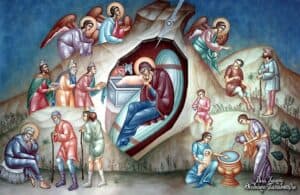 With brevity and theological precision, Saint Basil the Great describes the purpose of the Incarnation of the Son of God: “God took on flesh, because it was necessary to sanctify this flesh of ours, the flesh that had been cursed— to strengthen what had grown weak, to make familiar to Him what had become estranged, to restore to communion with Himself what had fallen away from God; the flesh that had fallen from Paradise, to raise it again to the heavens.” He accepted to become a humble man, in order to give human beings the possibility to be incorporated into God’s story, to be granted citizenship in His Kingdom, and to make deification their own. God walked upon the earth so that His presence, His justice, and His love would reign upon the earth— so that we might begin to taste Paradise even in this life.
A legitimate question
And yet today, as we journey through the twenty-first century since that singular night in Bethlehem, we often sense that our life has taken the shape of a personal hell. We do not enjoy or feel the precious gifts of God, and we often see that the traces of His footsteps on earth seem greatly faded: nations are in turmoil, peoples fight one another, society is shaken, colleagues compete with hostility, the family hearth falls apart, and brothers and sisters hold hatred in their hearts. Friendship is undermined, solidarity becomes rare, and humanity itself seems to vanish. Where, then, is the peace the angels sang? Where is the joy and the rest of the gifts that God brought to the earth?
A sincere answer to this troubling question presupposes two things: First, that we look at history beginning from the moment “the Word became flesh and dwelt among us” (Jn 1:14). And second, that we descend into the depths of our own being, seeking to explore the human existence.
With Christ or Without Christ
The Incarnation of God did not only divide world history into before Christ and after Christ — it also divided humanity into those who are with Christ and those who are without Christ. And the criterion of that division lies deep within every human soul. Jesus Christ — who was met by the God-fearing Simeon as “a sign that is spoken against,” and who was foretold by the prophets as “a stone that will make men stumble, a rock that will make them fall” — offers mercy and truth to all. Some build their salvation on these gifts, others disregard them as mere stones on the road. The first rejoice in becoming united with God; the others inevitably reap the painful consequences of their choice.
When Jesus was a newborn child, He was welcomed by the illiterate and humble shepherds of Bethlehem — while the well-read and knowledgeable students of the Scriptures, the pharisees and the sadducees, were at first indifferent and distant, and later unleashed against Him all the hostility and malice that lay within their hearts.
From the far-off East, wise men began their long journey so they could worship Him — while in Jerusalem, King Herod schemed to slay the “newborn king,” and forced the infant into exile and refugee-flight. (See Mt 2:1-5, 13-16.)
Later, the Lord proclaimed the gospel of His kingdom and “went about doing good and healing all who were oppressed by the devil.” (See Acts 10:38.) Many believed. They became His disciples, His children, depending on Him for their life and salvation. Among them were the demon-possessed, freed from their torment; the paralytics, restored to strength; the blind, granted sight; the sick, healed by the great Physician. The grateful plea of the former demon-possessed man of the Gadarenes to follow Him — made while his fellow townsmen, disturbed by the loss of their pigs, urged Him to depart from their region — attests to this. (See Lk 8:37-38.)
Jesus did not turn away the despised tax collectors and the defiled prostitutes who approached Him. He was the physician who came to heal those afflicted by every disease, whether of body or soul. The sinners who acknowledged their weakness received healing of body and soul — they tasted paradise. On the other hand, the pharisees and sadducees, with the illusion of spiritual health and the blindness of their arrogance, would not permit the Healer to approach them. And so they remained in sickness, in misery, in the darkness of sin.
Christ Is Not to Blame
If today the signs of Christ’s presence seem absent from our society, let us not rush to accuse Him. If our attitude toward Him is one of indifference or even rejection, then Christ is not to blame for our miserable state. Can I accuse the doctor when I refuse to follow the instructions and take the medicine he gives me, and yet continue to be ill? In the same way, I have no right to blame Christ when I do not live according to His Gospel, when I do not partake of the holy Mysteries, when I ignore His will in my life.
And even if I am a baptized Christian, even if I once began the christian life yet now feel that it no longer “satisfies” me, Christ is not at fault. I must not be quick to accuse Him, but first examine the quality of my own christianity. Could a subtle religious self-sufficiency be hiding within me? Could confidence in my own achievements be leading me, through pride, into spiritual blindness? Arrogance nullifies even the grace of God, for it does not permit it to operate in the soul.
The apostle Paul points to a striking historical example — the Jews. They were the chosen people whom God, through the voice of the prophets, had been awakening and preparing for centuries to await the Messiah. But when He finally came to them, they did not receive Him. They arrogantly rejected His call and refused to receive Him. Why? Because they did not like Him. He had come, as His works testified, “in the name of the Father,” yet they desired a Messiah shaped according to their own will. They would not acknowledge the divine power in the signs He performed; they attributed them instead to Beelzebul, the prince of demons. They sought to erect their own justice above the justice of God. But faith means complete dependence on God. It means that we are able to accept what He wishes to give us, even when it does not serve us, even when it does not please us. Otherwise, we show that we do not need Him, and we inevitably remain outside His blessing, outside His love.
Rejection of the Offering
It is a sorrowful truth that even today, among Christians, there are those who will celebrate Christmas without confession and without receiving Holy Communion. They are persuaded that they are people of the Church. They attend services fairly often and even give alms from time to time. Yet the moment someone speaks to them about Confession, they shrug their shoulders with indifference. “I am a person of God. I have not stolen, I have not killed, I do not harm anyone,” they reply, and they hide behind that response as though it were enough. They do not realize — to their own misfortune — that the greatest sin is pharisaism, the self-justification of the soul. It places the believer on the same level as those who deny Christ, because it does not accept divine grace but instead pushes it aside, refusing to receive the gifts offered by the God who became man.
“If you could save yourself on your own, what need was there for the Lord to come?” Saint Macarius of Egypt asks — and his question could not be more fitting. He then affirms: “Just as the eye cannot see without light, and no one can speak without a tongue, or hear without ears, or walk without feet, or work without hands, so without Jesus you cannot be saved, nor can you enter the kingdom of heaven.”